

Pastel Alternative: The Modern Feedback Tool for Growing Agencies

The Pastel Alternative Built for How Agencies Actually Work
You loved the simplicity of proxy-based feedback when Pastel pioneered it—paste a URL, generate a shareable link, collect client comments without asking anyone to install anything—but somewhere along the way, you started spending mental energy on canvas allocation instead of actual client work. The Solo plan caps you at 3 premium canvases, the Studio plan costs $99/month just to remove that limit, and on lower tiers you're racing against a 72-hour commenting window that expires just when feedback is getting useful. Switch to the feedback tool that treats unlimited projects as the baseline rather than the premium tier, and stop managing artificial constraints that don't help you deliver better work.
[Start 14-day free trial] No credit card required. Works with any website.
The Core Difference: Canvas Limits vs. Unlimited Projects
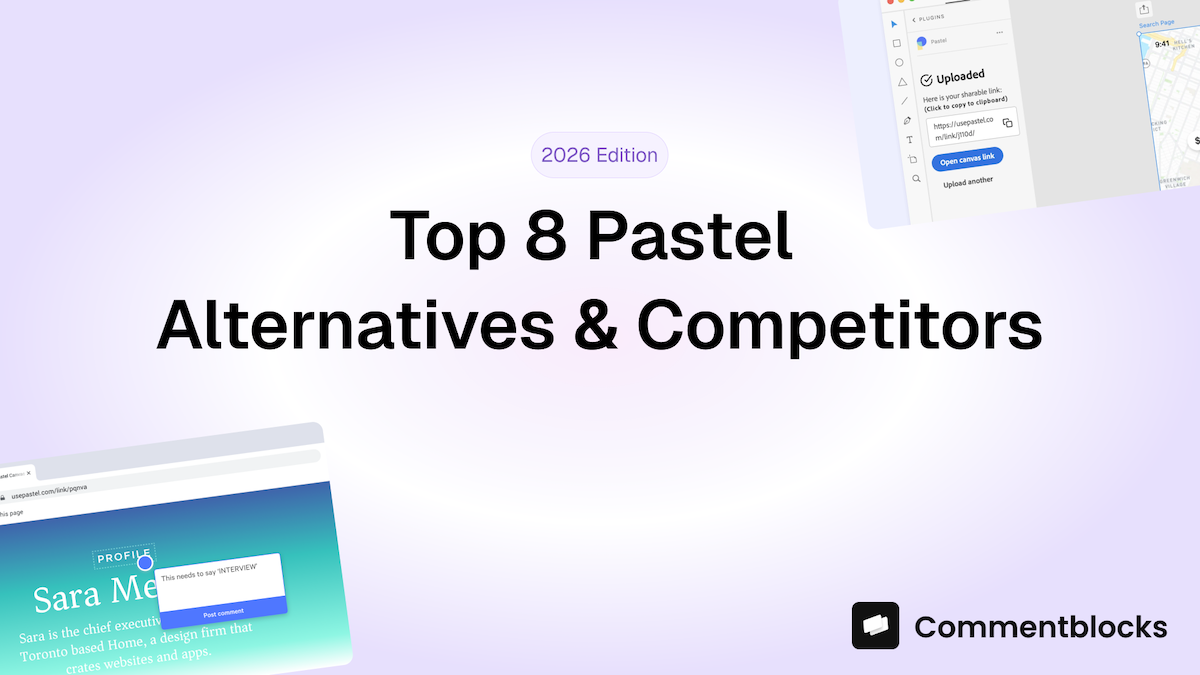
When Pastel entered the market, it genuinely changed how agencies thought about collecting client feedback on live websites—the proxy-based architecture meant you could generate a shareable link from any URL and let stakeholders comment directly on their website without requiring browser extensions, JavaScript snippets, or any installation whatsoever. I give Pastel full credit for proving that visual feedback could be friction-free for clients, and the simplicity of the experience attracted a loyal user base among agencies who were tired of walking clients through extension installations or debugging why feedback widgets weren't loading. The automatic capture of technical metadata like browser type, device, operating system, and screen resolution addressed developer needs, and the version tracking capability let teams monitor how feedback evolved across iterations. Pastel validated the proxy approach and demonstrated that agencies would pay for tools that eliminated the client-side installation barrier.
The tension that has driven many agencies to search for alternatives emerges from Pastel's pricing model and the artificial constraints it places on how teams can use the tool as their project volume scales. The Solo plan at $29/month limits you to just 3 premium canvases, which means you can only have three active feedback projects before you need to archive something to make room—and for any agency juggling more than a handful of concurrent clients, that limit arrives faster than you'd expect. Moving to the Studio plan removes the canvas limit but jumps to $99/month, which is a significant price increase for agencies who just need "more of the same" rather than additional features they'll actually use. The 72-hour commenting window on lower tiers adds time pressure to feedback cycles, forcing teams to collect input within an arbitrary deadline that doesn't match how busy clients actually review work over days or weeks. These constraints were perhaps acceptable when Pastel was one of the only zero-installation options, but alternatives have emerged that offer the same architecture without the artificial limits.
Commentblocks builds on the same proxy-based foundation that made Pastel successful but removes the constraints that hold growing agencies back. Instead of managing canvas limits and mentally tracking which projects deserve your premium slots, you work with unlimited projects for one predictable monthly price—creating a new project doesn't require archiving an old one, and there's no tier threshold that triggers painful pricing jumps when you scale. We've also eliminated time-based restrictions because feedback cycles don't respect arbitrary deadlines; clients review when they have time, and your feedback tool should accommodate that reality rather than forcing artificial urgency. The result is a tool that feels like what Pastel would be if it were built today for agencies managing significant project volume, with the lessons learned from how the market has evolved since Pastel pioneered the approach.
Why We Searched for an Alternative
The first pain point that drove us to search for alternatives was the per-canvas pricing model that created constant friction around project allocation and forced decisions that should never have needed making. Our agency typically manages 10-15 active client projects at various stages—some in active development receiving daily feedback, others in maintenance mode with occasional input, and new projects spinning up as old ones wind down. The Solo plan's 3-canvas limit meant we were constantly playing project Tetris: archiving projects that weren't quite finished to make room for urgent new work, then re-creating archived projects when older clients came back with feedback, losing context and continuity each time we had to shuffle the deck. I noticed myself spending mental energy on "which projects really need a canvas right now" instead of focusing on the actual design and development work, and that overhead felt increasingly absurd as our project volume grew. The Studio plan at $99/month would solve the limit problem, but tripling our feedback tool cost just to remove an artificial constraint felt like paying premium prices for what should be baseline functionality.
The second frustration that compounded the canvas issue was the 72-hour commenting window that expired just when feedback was getting useful on the projects that needed extended review cycles. Our clients aren't sitting at desks waiting to provide feedback—they're busy professionals who review work between meetings, during commutes, and in the spare moments scattered throughout packed weeks. Some clients turn around feedback in a day, but others need a week or more to loop in the right stakeholders and compile thoughtful input, and an arbitrary 72-hour window doesn't accommodate that reality. We had projects where the commenting window expired mid-review, forcing us to recreate the canvas and resend links, which confused clients who'd bookmarked the original URL and created administrative overhead that shouldn't exist. The time restriction felt designed to push agencies toward higher pricing tiers rather than reflecting any genuine product limitation.
The third issue we encountered as we scaled was the mobile experience that felt increasingly inadequate as we tracked where client feedback actually originated. A significant portion of our clients review work on phones—during commutes, between meetings, standing in line for coffee—and Pastel's mobile experience always felt like desktop squeezed onto a smaller screen rather than a native mobile workflow. Touch interaction was cumbersome, the interface elements felt too small, and clients who tried to leave feedback on their iPhones often gave up and promised to review "properly" on their computers later, which frequently meant feedback never arrived at all. The proxy architecture should enable excellent mobile experiences because there's nothing to install on the device, but Pastel never fully capitalized on that opportunity.
The fourth pain point was the text-only commenting limitation that became more apparent as competitors added richer feedback formats. Pastel lets clients drop text comments on canvases, but there's no audio feedback option for stakeholders who think faster than they type, no video recording for complex explanations that don't translate well to written words, and no screen recording for showing exactly how something behaves rather than describing it. Some of our clients prefer verbal feedback because they can articulate nuance more quickly when speaking, and forcing everyone into text-only commenting meant we were adapting our clients to the tool's limitations rather than the tool adapting to different communication styles.
Evaluating Alternatives
With these pain points clearly identified, we evaluated several alternatives over a few weeks before settling on Commentblocks. We were specifically looking for tools that shared Pastel's zero-installation proxy architecture—we weren't willing to go backward to extension-based solutions—but that addressed the pricing model and feature gaps that had become friction points.
We evaluated Markup.io, which also uses proxy-based architecture and built its reputation on the same zero-installation experience that made Pastel attractive initially. The unlimited project approach at a flat rate was closer to what we wanted, and the Loom integration for video feedback addressed the text-only limitation we'd felt with Pastel. However, Markup.io underwent a significant price increase in January 2025 that raised the Pro plan from $29 to $79 per month, which was actually higher than what we were paying for Pastel's Solo plan. We also found that comment management became cumbersome as projects accumulated feedback—resolved comments lingered in growing lists that were difficult to navigate—and the mobile experience still felt like a secondary consideration compared to desktop workflows.
We also looked at Feedbucket, which approached the problem from a different architectural angle by using embedded widgets rather than proxy overlays. The integration depth with project management tools was impressive, and the console log recording added technical value for debugging JavaScript issues. However, Feedbucket requires JavaScript snippet installation on websites you want to collect feedback on, which reintroduced the installation friction we'd specifically escaped by using proxy-based tools—the "please install this script" conversation was exactly what we'd avoided by choosing Pastel originally. The architecture is powerful for teams who control their entire codebase, but it didn't fit our workflow of collecting feedback on client-owned staging environments where we don't always have quick access to add scripts.
What these evaluations clarified was that proxy-based architecture was non-negotiable for our workflow, but we wanted flat-rate unlimited pricing, mobile-first design, and ideally richer feedback formats—all without the canvas allocation overhead that Pastel had trained us to resent.
How Commentblocks Solves Each Pain Point
The unlimited project model eliminates the canvas allocation overhead that was consuming mental energy and creating artificial constraints on how we managed client work. With Commentblocks, creating a new project is as simple as pasting a URL—there's no counting against a limit, no calculation about which existing project to archive, and no tier threshold that triggers pricing jumps when we scale beyond an arbitrary number. We stopped thinking about our feedback tool's constraints and started thinking purely about the work, which is exactly how utility software should function. Our project managers no longer ask "do we have a canvas available?" before creating feedback links, and the administrative overhead of juggling allocation disappeared entirely. The mental relief was more significant than I expected—I hadn't fully appreciated how much background cognitive load the canvas management was consuming until it was gone.
The elimination of time-based restrictions means feedback cycles can proceed at whatever pace our clients actually operate, without artificial urgency that doesn't serve anyone's interests. Some clients review work the same day we send feedback links; others need two weeks to coordinate among stakeholders, schedule review time, and provide thoughtful input across multiple pages. Commentblocks doesn't impose arbitrary windows that expire mid-review, so clients can bookmark feedback links and return whenever their schedule allows. The feedback tool accommodates how busy professionals actually work rather than forcing artificial deadlines that lead to rushed, incomplete reviews or awkward "I need to resend you a new link" conversations. Feedback quality improved because clients stopped feeling time pressure that didn't align with how they manage their priorities.
The mobile-first design philosophy addresses the gap we felt in Pastel's desktop-focused approach by treating phones and tablets as primary review devices rather than afterthoughts. Because Commentblocks uses the same proxy architecture, there's nothing to install on any device—clients tap a feedback link on their iPhone, see their website rendered at the device's native resolution, and leave comments with a touch interface designed for finger interaction rather than mouse precision. We started capturing significantly more feedback from the executives and decision-makers who were always on the move, because the mobile experience no longer discouraged participation. The device and resolution metadata attached to each comment tells developers exactly what viewport clients were reviewing at, which is particularly valuable for responsive design issues that only manifest at specific screen sizes.
The integration with our existing project management workflow means feedback flows into actionable tasks without manual transfer steps or parallel tracking systems. When clients leave comments, the feedback enters our PM tool with full technical metadata attached, and status changes sync bidirectionally so we're not maintaining duplicate state across platforms. Pastel's limited integration options had forced us to manually copy feedback into task descriptions, which was time-consuming and error-prone—tasks would reference feedback that we'd then need to find again in Pastel's interface. The tighter integration means we spend less time on administrative transfer and more time on the actual work that feedback is meant to inform.
The Verdict
I want to be specific about when Pastel remains the right choice, because the tool does work well for certain workflows and the switching cost isn't zero even when both tools share similar architecture. Stick with Pastel if you're a solo designer or very small agency who genuinely runs just 2-3 concurrent projects at any time and the canvas limit never constrains you—the Solo plan at $29/month is fair pricing for that use case, and the tool executes the core proxy-based workflow reliably. Pastel also makes sense if you're already on the Studio or Enterprise plans where canvas limits don't apply and your workflow has adapted around the integration limitations and text-only commenting without significant friction. If you've built processes around Pastel's specific interface and version tracking features, and the mobile limitations don't impact your workflow because your clients primarily review on desktop, the transition effort may not be worth the improvement.
Switch to Commentblocks if you're a growing agency juggling more projects than Pastel's Solo plan allows and you're tired of paying nearly $100/month just to remove artificial canvas limits. If you've ever archived a project prematurely to free up a canvas slot, hit the 72-hour commenting window during an extended review cycle, wished for better mobile feedback experiences from stakeholders who review on phones, or wanted richer feedback formats beyond text comments—Commentblocks is the modern alternative built to address exactly these pain points. We share the same proxy-based zero-installation architecture that made Pastel successful, so the client experience transfers directly, but we've eliminated the constraints that no longer make sense for agencies managing significant project volume in 2026. The tool does what Pastel does, without the limits that Pastel imposes, at pricing that treats unlimited projects as baseline rather than premium.

Blog: Tips & Insights
Tips, strategies, and updates on client management, web development, and product news from the Commentblocks team.


Frequently Asked Questions
.svg)

Ready to collect feedback the right way?